
Short-Term Promotions vs Long-Term Loyalty
Every brand wants two things at once: a spike in sales right now and a base of customers who keep coming back for years. Short-term promotions and long-term loyalty programmes are the two main tools for achieving those goals, but they pull in different directions and choosing one at the expense of the other rarely ends well.
At Cloud Nine Incentives, we work with brands across different sectors to design campaigns that generate genuine excitement and durable customer relationships. The question we’re asked most often isn’t “which approach is better?” — it’s “how do we make both work together?” That’s exactly what we’re about to discuss.
What Short-Term Promotions do Well
A well-executed prize promotion, flash giveaway or limited-time incentive can do things that no loyalty scheme can replicate quickly. When a campaign is time-limited, it creates urgency. When the prize is desirable, it creates conversation. When entry is simple, it lowers the barrier for people who’ve never engaged with your brand before.
Short-term promotions are particularly effective for:
- Launching a new product or service to a cold audience
- Re-engaging lapsed customers who’ve drifted away
- Driving footfall or website traffic during quieter trading periods
- Generating social media reach and user-generated content
- Supporting a seasonal sales push with a memorable hook
The limitation, of course, is that the uplift rarely lasts. Once the promotion ends, most participants move on — especially if there was nothing beyond the incentive to keep them engaged. A brand that relies exclusively on short bursts of promotional activity often finds itself on a treadmill, spending more each cycle just to maintain the same results.
What Long-Term Loyalty Programmes Achieve
A loyalty programme is a different kind of investment. Rather than chasing a spike, it focuses on the lifetime value of a customer — the cumulative revenue, referrals and brand advocacy that a genuinely satisfied, repeatedly rewarded customer generates over months and years.
Done properly, loyalty programmes build habits. A customer who earns points, unlocks tiers or receives personalised rewards has a structural reason to return that has nothing to do with whether a promotion is currently running. That consistency is hard to disrupt and it compounds over time.
Loyalty schemes also generate data. The more a customer interacts with a structured programme, the better a brand understands their preferences, purchase frequency and sensitivity to different types of reward — intelligence that feeds back into smarter campaigns.
The drawback is that loyalty programmes take time to embed, cost more to build and manage and require genuine commitment from the business. A poorly maintained scheme (one where points expire silently, rewards are underwhelming or the interface is clunky) can actually damage brand perception rather than improve it.

Why The Either/Or Framing Misses The Point
The most effective brands don’t treat promotions and loyalty as competitors. They treat them as different stages of the same customer journey.
A short-term promotion is often the introduction — the moment a new customer first engages with a brand in a meaningful way. The prize, competition or incentive gets them through the door. What happens next determines whether they stay.
If a brand has a loyalty programme waiting on the other side of that door, the promotional moments become a recruitment tool. The customer who enters a competition in January might, by March, be a loyalty member making their fourth purchase. Without the programme, they were always going to be a one-time entrant. With it, they become part of a growing retained customer base.
That transition, from promotional participant to loyal customer, is exactly what prize management is designed to facilitate when it’s planned thoughtfully from the outset.
How to Balance The Two in Practice
Getting the balance right comes down to a few practical principles:
- Align your promotional objectives with your loyalty goals. If your loyalty scheme rewards repeat purchase, design promotions that encourage a first or second transaction rather than just a single entry
- Capture data at every promotional touchpoint. A competition entry is only as valuable as the permission and preference data you collect alongside it
- Use promotions to recruit, not just to sell. The most cost-effective use of a short-term campaign is to bring new people into a longer journey, not to extract one sale and move on
- Keep loyalty rewards meaningful. Customers disengage from schemes where the rewards feel token. The prize or perk needs to reflect genuine value
- Measure the right metrics. Short-term promotions are easy to measure on entries and reach. Loyalty programmes need to be measured on retention rates, repeat purchase frequency and customer lifetime value

When to Lean One Way or The Other
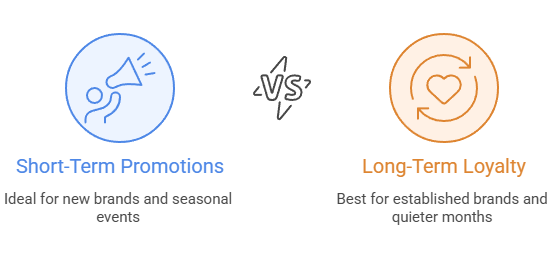
Neither tool is universally appropriate at every stage. A brand in its first year may need the reach and noise that only a strong promotional push can deliver, before a loyalty scheme is viable. An established brand with a healthy customer base may find that loyalty investment delivers a far better return than yet another flash competition.
Seasonal context matters too. Christmas, summer and key retail moments are natural homes for short-term incentive activity. The quieter months in between are often better used to deepen loyalty, communicate with existing members and refine the rewards on offer.
The honest answer is that there’s no fixed ratio that works for every brand. What matters is that both tools are being used deliberately, with clear objectives, proper measurement and a plan for how each one feeds into the other.
At Cloud Nine Incentives, we specialise in prize management that goes beyond the competition itself — helping brands to design campaigns with clear purpose and a structure that turns short-term excitement into long-term value. Talk to our team to plan your prize incentive today.