
What You Need to Know About Setting Goals for Travel Incentives
Why Goal-Setting Matters
for Travel Incentive Programmes
Travel incentives are an investment in your team’s motivation and performance. If you don’t have clear goals, even the most luxurious of destinations will lose its power to drive meaningful results. Here at Cloud Nine Incentives, we’ve seen firsthand how proper goal-setting transforms a simple reward into a strategic tool that delivers measurable business outcomes.
The difference between an incentive that will create excitement and one that falls flat often comes down to how well the goals align with the company objectives and the employees own aspirations. When your team understands what they are working towards and they believe the goal is achievable, you will notice how engagement soars.

Align Your Incentives with Business Goals
Your travel incentive programme should never exist as a standalone objective. Start by identifying specific business outcomes that you want to achieve. Are you looking to increase sales by a certain percentage? Improve customer retention rates? Boost productivity in a particular department? Once you’ve chosen your primary business objective, build your goals to directly support it. If you’re focused on revenue growth, set targets based on sales figures or contract values. For customer service improvements, consider data such as the satisfaction scores or response time.
Make Your Goals Specific
Vague objectives like “work harder” or “do better”, won’t motivate your employees. Your goals need to be specific and easy to track. Instead of asking your team to “increase sales”, set a target of “achieve £50,000 in a new business by the 31st of March”.
Measurable goals have several advantages:
- Participants know exactly where they stand at any given moment
- Progress can be tracked and celebrated along the way
- There’s no ambiguity about who had qualified for the reward
- You can analyse the programme’s return on investment with precision
When your team can see their progress updating in real time, it reinforces the fairness of the programme and maintains momentum.

Ensure Goals are Challenging yet Achievable
Finding the perfect balance between challenging and achievable is one of the trickiest parts of incentive design. If you set the bar too low you’ll end up paying out rewards without getting significant performance improvements. Yet, if you set it too high people will dismiss the goal as impossible, turning away before they even give it a go.
We recommend analysing historical performance data to set realistic benchmarks. Look at your top performers’ achievements over the past year, then set goals that stretch your team beyond their comfort zone without requiring superhuman effort. A good rule of thumb is to aim for targets that your top 20-30% of performers can reasonably achieve with focused effort.
Consider implementing tiered goals as well. Bronze, silver and gold levels allow more participants to experience success whilst still rewarding exceptional performance with premium destinations.
Create a Clear Timeline
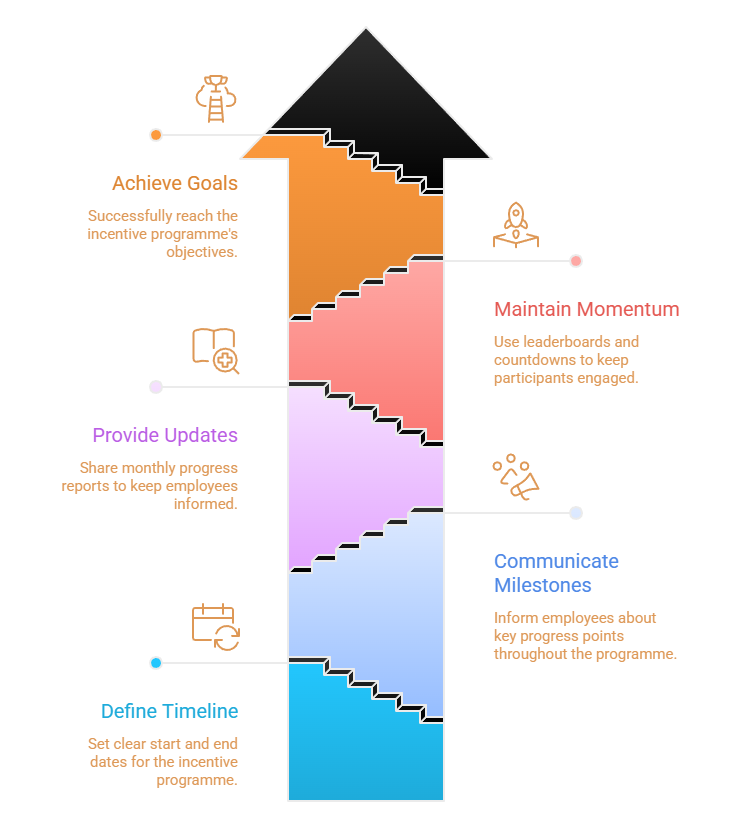
Open-ended goals lack urgency. Your incentive programme needs defined start and end dates that make a compelling timeframe for action. Quarterly programmes work well because they’re long enough to allow meaningful progress and short enough to maintain focus.
The ideal length depends on your specific goals and industry cycle. Sales teams with longer deal cycles may need six-month programmes, whilst customer service improvements might benefit from shorter, more frequent incentives that keep motivation high year-round.
Communicate the key milestones throughout the programme period. Give your employees monthly progress updates, keep a leaderboard and have countdown reminders to help maintain momentum and keep the destination firmly in participants’ minds.
Consider Team Versus Individual Goals
Individual competition drives performance for some personalities, whilst others thrive in collaborative environments. The right choice for your business depends on your company culture and the type of work being incentivised.
Individual goals work especially well for sales roles where performance can be clearly attributed to specific people. Team-based goals suit situations where collaboration is essential to success, such as project delivery or departmental targets. Some programmes effectively combine both, rewarding individual achievement within a broader team context.
Communicate Goals Clearly
From the Start
Even the most perfectly designed goals will fail if your team doesn’t understand them. Launch your incentive programme with crystal-clear communication that covers:
- Exactly what needs to be achieved
- How performance will be measured
- The timeline for the programme
- The destination and what’s included
- How participants can track their progress
Provide this information in multiple formats through team meetings, email, posters and your company intranet. The more visible the programme, the more it will influence daily decisions and priorities.

Plan for Tracking and Adjustment
Build in regular review points where you can assess whether the programme is delivering the desired results. If participation is lower than expected or early data suggests the goals need refinement, don’t be afraid to make adjustments. A mid-programme course correction is better than persisting with an incentive that isn’t working.
At Cloud Nine Incentives, we work with you to establish the right goals from the outset, then manage every aspect of delivering the travel prize that makes all the effort worthwhile. When goals are set thoughtfully and rewards are genuinely desirable, the results speak for themselves. Get in contact with a member of our team to discuss your travel incentives today.